

Every CRO has seen this movie before… The pipeline looks healthy. The CRM activity looks good. Deals are marked “qualified.” Then the quarter closes, and the number is missed. Again.
There is a big difference between checking the right boxes in the CRM and asking the hard questions on the call to uncover the grounded truth about the deal.
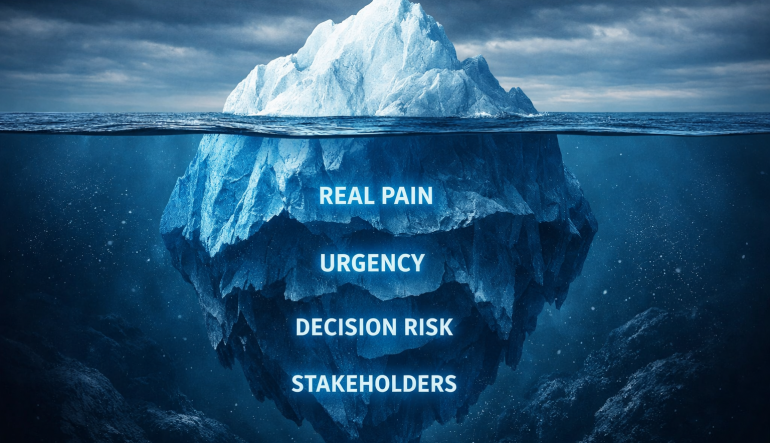
Most sales teams are operating at the tip of the iceberg; what is visible looks solid. What sits underneath is where deals are actually won or lost.
What’s Happening Under the Surface
On the surface, everything checks out:
- Compelling event? Logged
- Pain identified? Confirmed
- Decision process? Documented
But beneath the surface:
- The “pain” is vague and non-urgent
- The “compelling event” has no real consequence
- The “decision process” is based on one person’s opinion
This is the gap between checking the box and knowing the truth.
Unfortunately, it is a very expensive gap.
Why Surface-Level Selling Persists
No one sets out to sell this way. It happens because the system rewards it.
1. Methodologies Become Compliance Exercises
Frameworks like MEDDICC, SPIN, Sandler, and SNAP were built to drive rigor. Instead, they often become:
- A checklist to complete
- A field to populate
- A step to “get through”
Reps learn how to answer the framework questions in the CRM, not uncover reality.
2. Managers Inspect Activity, Not Insight
Most 1:1s sound like this:
- “Did you ask about the timeline?”
- “Do we have a compelling event?”
Rarely:
- “What actually happens if they do nothing?”
- “Who said that, and how confident are we?”
Managers are reviewing inputs, not understanding. That is why coaching feels transactional and why it fails to change behavior.
3. Time Pressure Rewards Shallow Thinking
When managers are overwhelmed, and reps are chasing numbers, depth feels like a luxury. So teams default to speed: move the deal forward, and log the activity quickly, but speed without depth creates fragile pipelines.
High-performing Team Operate Differently
In one word, it’s execution. The issue is rarely that reps are skipping steps; it is that they are stopping one or two layers too early. They ask the first question from the training, but then they accept the first answer and move on. What is missing is the discipline to double-click on that answer and go deeper.
High-performing teams treat every answer as the beginning of the conversation, not the end.
They Go Two Layers Deeper
When a prospect says, “We need to improve this,” great teams ask:
- “What specifically is happening today?”
- “What breaks if this doesn’t change?”
- “Who feels that impact the most?”
They are not collecting answers; they are building certainty.
They Validate the Source
Not all answers carry equal weight.
- Was this said by a decision-maker or a user?
- Is this an opinion or a mandate?
- Has this been validated across stakeholders?
Most deals fall apart because the “truth” came from the wrong person.
They Coach to Conversations, Not CRM Fields
Effective coaching does not start with the dashboard. It starts with listening to calls, interpreting tone and hesitation, and challenging assumptions, because the real signal lies in how it was said and what was left unsaid.
What Leaders Must Do Differently
If you want your team to go deeper, you have to model it.
1. Change the Questions You Ask
Shift from inspection to thinking
- “What do we know for sure?”
- “What are we assuming?”
- “What would have to be true for this deal to close?”
2. Make Depth the Standard
Reps should not get credit for asking the question. They should get credit for:
- Diagnosing the problem
- Validating the impact
- Confirming the consequence of inaction
3. Turn 1:1s Into Skill Development
Most 1:1s are deal reviews. They should be:
- Coaching sessions
- Pattern recognition exercises
- Skill-building conversations
If your managers are only talking about deals, they are managing outcomes, not improving them. This is one of the most common failure points across sales organizations today: coaching exists in theory but not in practice.
Where AI Changes the Game
You can’t coach what you can’t see. Modern systems should help, not by adding more dashboards, but by surfacing what actually matters.
The goal is to shift from data to insight and from insight to action. Your systems should deliver a clear direction on where to coach.
CoachEm analyzes real sales behavior across calls, emails, and activity to surface where reps are staying shallow, where deals lack real urgency, and where coaching will actually move the needle. Instead of guessing what to work on, your managers get clear, data-backed direction on how to go deeper with each rep, every week.
The result is simple: better conversations, stronger pipelines, and fewer surprises at the end of the quarter.
If you want your team operating below the surface, it starts here.
- Surface-level selling creates false confidence.
- False confidence creates bad forecasts.
- Bad forecasts cost real money.
If you want to fix your pipeline, do not start with more processes. Start by going deeper.